Is it completely pseudorandom or it does use some kind of algorithm?
Is getting UV is same for everyone?
Wed, 09/14/2011 - 09:57

Wed, 09/14/2011 - 11:50
#2
And to expound it is
And to expound it is estimated to be a 1% chance at 2 UVs and .1% for three. No actual numbers, I believe.
Wed, 09/14/2011 - 11:59
#3

Following the title, getting
Following the title, getting UVs is the same for everyone.
btw pseudorandom is some kind of algorithm
Wed, 09/14/2011 - 14:07
#4
I posted because there seems
I posted because there seems to be some kind of pattern.
In some periods of time i get 3-4 UVs when craft 10 items.
But sometimes i get no UV when craft 20-30 items.
Also 3 days before I was getting 1 UV when crafting 6 items in average.
Now I am getting UV when crafting 12 items.
Btw I crafted more than 300.
It is so confusing.
PS: Is there a reference where it says that getting UVs is completely pseudorandom and is same for everyone? Or is it just something you assume to be right?
Wed, 09/14/2011 - 15:00
#5
Yeah
We are really good at seeing patterns in random data. In fact, what we would describe as "random" isn't random at all, it would be too perfectly distributed to be random.
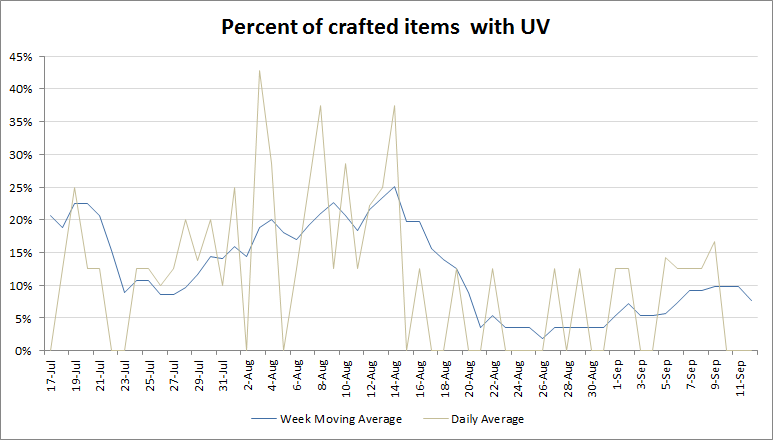
I noticed similar patterns. Would be getting 20% UVs one week, measly 4% some other week... over the long run it averages out to about 12% thus far from my data:
http://i1112.photobucket.com/albums/k488/CultureHunter/uv-chart.png
Funny story - a statistics professor would break the class into two. After he left the room, one side would flip a coin 100 times and write the series of results on the blackboard. The other would write down their own list of 100 "random" results, but without using a coin. The professor would not know which side used the coin, but when he walked back into the room it was easy to tell. The side that used a coin is very likely to have a series of 8+ of the same result. The ones that didn't use a coin wouldn't put more than 4 in a row - that just wouldn't look random.
One thing to check though, does our data sets dip and spike at the same places? Maybe they've been changing the formula without telling us. /conspiracy

Theres a % of a chance for you to get a UV when crafting an item. This % i the same for every item crafted and for every person that crafts it. % to get one UV on an items is believed to be about 10% and its been tested enough to be just about fact.